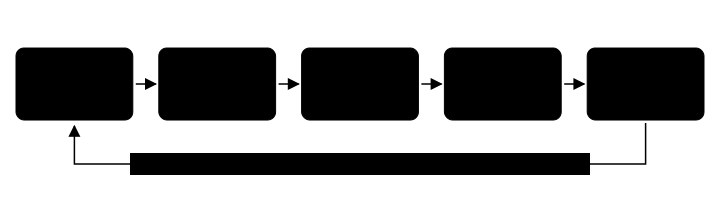
To improve your vocabulary, read material slightly above your level, look up unfamiliar words in the sentence where you meet them, save the sentence, and review each word at spaced intervals until you recall it without help. That is the whole method. Everything below explains why it works, why the popular alternatives don’t, and how to do it for thirty days.
Why word lists and word-of-the-day apps don’t work
Most vocabulary advice fails for the same reason. It tries to teach words in isolation.
A word list gives you a word and a definition. That’s two facts with no thread connecting them to anything you already know. You can memorise the pair for a test, and people do, but a fortnight later the word has gone. It never had a sentence to live in, so it had nothing to attach to.
Word-of-the-day apps fail the same way with better design. One word, one definition, one push notification. Even if you read every one, you meet each word once. As the next section explains, once is nowhere near enough.
Flashcards on their own are a partial fix. They add spacing, which matters. But a card made from a dictionary entry still carries a word with no context, and the definition on the back tends to be the general one, not the meaning the word had when you actually needed it.
The pattern across all three: the words never enter your life through reading or listening, so your brain has no reason to keep them.
How vocabulary is actually learned
Almost all of the vocabulary you know, in any language, you learned without meaning to. Nobody gave you a list with reluctant and threshold on it. You met them in sentences, worked out roughly what they meant, met them again, and refined the meaning each time until the word was yours. Linguists call this incidental learning, and it is how native speakers reach vocabularies of tens of thousands of words with no study at all.
Two findings from the research on incidental learning shape everything else in this article.
One encounter almost never teaches a word. When Nagy, Herman and Anderson measured what school readers picked up from a single meeting with an unfamiliar word in a natural text, the chance of learning it came out at around one in ten.1 Not zero, which is why reading works at all, but low. Webb’s later experiments varied the number of encounters and found that meaning and use settle in after roughly ten meetings, with knowledge still growing between the seventh and the tenth.2 Call it eight to twelve. That is the number you’re working against.
Context is what makes a word memorable. A word met in a sentence you cared about arrives with a meaning, a tone, a topic, and a memory of where you were when you read it. That is a lot of hooks. A word met in a list arrives with none. This is why you remember a word you looked up in a novel three years ago and forget one you drilled last month.
Put those two together and the task becomes clear. You need to meet words many times, in context, and you need to stop the meetings from going to waste.
How to learn vocabulary from reading
Reading is the highest-volume source of new words available to you. A typical novel has several thousand distinct word forms in it. A serious weekly magazine runs a few hundred words most readers won’t know. Nothing else you can do exposes you to that many candidates for your vocabulary. The question is how to read so that they stick.
Read slightly above your level
Comprehension research gives a useful rule of thumb. If you know about 98 per cent of the words on a page, you read comfortably and pick up the remaining 2 per cent from context. At 95 per cent you can still follow, but it takes effort and you learn less. Below that, the text becomes a decoding exercise and incidental learning stops. Hu and Nation found that almost no readers reached adequate comprehension at 95 per cent coverage and most did at 98 per cent,3 and Schmitt, Jiang and Grabe later showed the relationship to be roughly linear, with no cliff, which is why “slightly above your level” is the target rather than “as hard as you can bear”.4
In practice: pick books and articles where you hit a word you don’t know every paragraph or two, not every line. If you’re looking up more than a handful of words per page, the material is too hard for now. If you’re looking up none, it’s not growing you.
Look up the word in its sentence, not in a dictionary tab
When you meet a word you don’t know, the worst thing you can do is nothing. The second worst is to open a new tab, type the word into a dictionary, read six senses, and lose your place. By the time you return to the page, the sentence has gone cold.
What you want is the meaning the word has here, in this sentence, and then back to reading. That is the difference between a dictionary and a context-aware lookup. A dictionary tells you what a word can mean. Context tells you what it does mean, and that is the version your memory can hold on to.
This is what Lexiora does when you select a word on any page. It reads the surrounding sentence and gives you the meaning that fits, in your own language if you’re reading in a second one, plus synonyms and a one-line memory cue. Then it saves the word with the sentence you found it in, so the context travels with the word instead of evaporating.
Keep the sentence
Whatever tool you use, keep the sentence. The sentence is the context, and the context is the memory. A notebook works. A spreadsheet works. Kindle’s Vocabulary Builder keeps the sentence too, which is the best thing about it. What matters is that when you see the word again later, you see it where you first met it.
Read a lot, and read what you like
The eight-to-twelve encounters have to come from somewhere. No lookup tool can manufacture them for you. They come from volume, and volume comes from reading things you actually want to read. A reader who gets through a novel a month meets far more repeated vocabulary than one who grinds through a textbook chapter a week. Curiosity is not a nice-to-have here. It’s the engine.
How to memorise vocabulary so it stays
Reading brings words in. Review keeps them from leaving. The two work together, and most people do only the first.
The reason review is needed at all is that memory fades on a predictable curve. A word you learned this morning is much weaker by tonight and mostly gone in a week unless something brings it back. Ebbinghaus first measured the forgetting curve on himself in the 1880s, and a careful replication in 2015 reproduced its shape almost exactly.5 It applies to vocabulary as much as to anything else.
Two techniques from a century of memory research counter it.
Spacing. Reviewing a word several times spread across days beats reviewing it the same number of times in one sitting. A meta-analysis of 254 studies found the advantage to be one of the most consistent results in the field, and found that the best gap between reviews grows as the interval you want to remember across grows.6
Retrieval. Trying to recall a word’s meaning from memory, even when you fail, strengthens it far more than re-reading the definition. In Roediger and Karpicke’s experiments, students who tested themselves remembered far more a week later than students who spent the same time re-studying, even though re-studying felt more productive at the time.7 Testing yourself is not a way of measuring learning. It is learning.
Spaced repetition systems combine both. They show you a word, ask you to recall it, and schedule the next review based on how well you did. A word you know well drifts out to a review in weeks or months. A word you fumble comes back tomorrow.
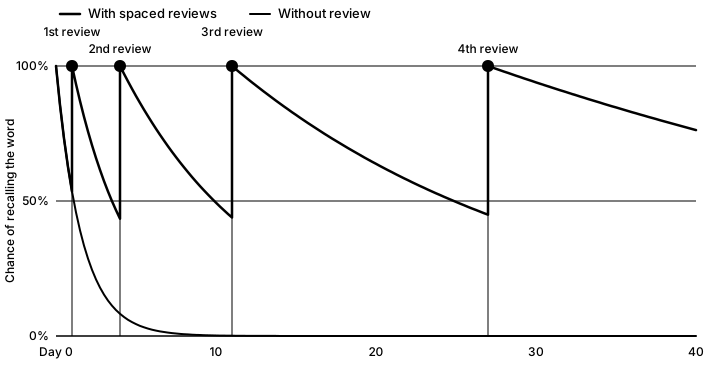
Here is roughly what that schedule looks like for a word you keep getting right. The exact intervals depend on the algorithm and on you.
| Review | Days since last review | Days since first meeting |
|---|---|---|
| 1st | 1 | 1 |
| 2nd | 3 | 4 |
| 3rd | 7 | 11 |
| 4th | 16 | 27 |
| 5th | 35 | 62 |
| 6th | 75 | 137 |
Six short reviews over four months, and the word is durable. Miss the reviews and you rely on chance re-encounters instead, which for a word you meet once a year means you never learn it.
Older algorithms like the one behind classic Anki used fixed multipliers. Newer ones, such as FSRS, model your memory of each word individually and adjust the gaps to your actual forgetting, which means fewer reviews for the same retention.8 The gains are real but modest. Any spacing beats no spacing by a wide margin.
Lexiora’s review uses FSRS, and every word you look up becomes a review card automatically, with the original sentence on it. A session is a few minutes a day. That is the point at which looking words up stops being a detour and starts being how your vocabulary grows. If you’d rather build the habit yourself, the science of mnemonics and etymology as a memory hook both give you more to attach a word to.
How to expand your English vocabulary as a second-language reader
If English isn’t your first language, everything above applies, and a few numbers help you aim.
Researchers describe vocabulary size in word families: decide, decision, decisive and undecided count as one. On that measure, the estimates for reading comfortably are sobering and useful.
| Goal | Approximate word families needed |
|---|---|
| Follow everyday conversation (about 95% of words known)9 | 2,000 to 3,000 |
| Read newspapers and novels with effort (95% coverage)10 | 4,000 to 5,000 |
| Read them comfortably (98% coverage)11 | 8,000 to 9,000 |
| Educated adult native speaker12 | 17,000 to 20,000 |
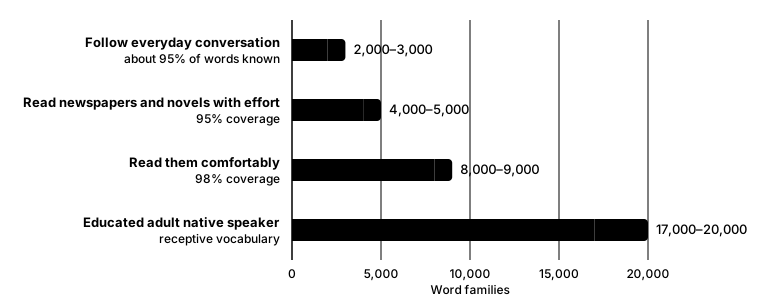
These are approximations drawn from corpus studies, and the exact figures vary by study, but the shape is consistent. Counted as individual dictionary words rather than families, the numbers are larger still: a 20-year-old native speaker of American English knows around 42,000.13 The gap between “can talk to people” and “can read The Economist without a dictionary” is about 5,000 word families. Most of them are not exotic. They are the mid-frequency words that appear once every few pages, which is precisely too rarely to learn from exposure alone and precisely why a second-language reader needs review more than a native one does.
Three adjustments to the method:
- Look up in your own language when the meaning is abstract. A definition in the target language is good practice, but for words like notwithstanding or hitherto, a translation gets you back to reading faster. Lexiora lets you set the language your explanations arrive in, so you can read in English and understand in Spanish, French, German, Portuguese or Italian.
- Read at the level you want to reach, not the level you’re at. Graded readers are fine at A2. By B2 you should be reading real articles about things you care about, accepting the slower pace for a few months. The vocabulary of your field, your hobbies and your news is the vocabulary you’ll actually use.
- Don’t translate the whole sentence unless you have to. Working out a sentence from the words you know plus one lookup is the incidental learning happening. A full translation skips it.
How to learn vocabulary faster
There’s an honest answer here and a dishonest one. The dishonest one sells courses.
You cannot compress the encounters. A word needs to come back to you several times over several weeks, and no technique changes that. What you can do is stop wasting the encounters you already have.
Most readers look up a word, understand it, and lose it. That is an encounter thrown away. The whole gain from the method in this article comes from converting encounters that would have been wasted into encounters that count. A reader who looks up twenty words a week and keeps none of them learns almost nothing. A reader who looks up the same twenty, keeps the sentence and reviews for five minutes a day learns most of them. Same reading. Same time. The difference is leakage.
So the real answer to “how do I learn vocabulary faster” is: look up more, lose less. Read more than you think you should. Look up everything you don’t know without guilt. Let a system handle the coming-back. Speed comes from volume plus retention, not from a trick.
A 30-day plan
This assumes you already read something most days. If you don’t, start there and come back.
Week 1: capture. Read what you’d read anyway. Look up every word you don’t know, in context, and keep the sentence. Don’t review yet. Just notice how many words you meet in a week that you’d have let go. For most readers it is thirty to sixty.
Week 2: add review. Begin five minutes of spaced review each day using whatever holds your words. Keep looking up. You’ll notice the first week’s words coming back, and you’ll notice some of them appearing in your reading, which is the eight-to-twelve encounters starting to accumulate.
Week 3: raise the level. Move to something slightly harder. A denser author, a longer-form magazine, a subject you don’t know. Your lookup rate goes up. That’s the intent.
Week 4: use them. Pick five words from your first two weeks and use each in something you write or say. An email, a message, a note to yourself. Production is the final step in moving a word from passive to active vocabulary, and it’s the step people skip.
At the end of thirty days you’ll have met and kept a hundred or more words, and you’ll have a habit that costs you nothing beyond what you were reading anyway. Continue it and the arithmetic does the rest.
Frequently asked questions
How long does it take to improve your vocabulary?
Noticeably, about three months. A reader who looks up and reviews consistently adds several hundred durable words in that time, enough to feel the difference when reading. Substantially, a year or more. Vocabulary growth is slow because each word needs weeks of spaced encounters, but it is cumulative and it doesn’t plateau.
How many new words should I learn a day?
Fewer than you’d guess. Five to ten words a day, kept, beats fifty looked up and lost. Since review load grows with the words you add, most people find ten a day sustainable and twenty a day not. Let your reading set the pace rather than a target.
Does reading really improve vocabulary?
Yes, and it’s the main way anyone’s vocabulary grows after childhood. But reading alone is slow, because most words appear too rarely for repeated exposure to teach them. Reading plus looking up in context plus spaced review is many times faster than reading alone, for the same reading time.
What is the fastest way to improve vocabulary?
Stop losing words you already look up. Save each one with its sentence and review it at spaced intervals. There is no method that skips the repeated encounters, so the fastest method is the one that wastes the fewest.
Is it too late to improve my vocabulary as an adult?
No. Vocabulary keeps growing throughout adult life; in the largest study of English vocabulary size to date, people in their sixties knew thousands more words than people in their twenties.13 What changes is exposure. Adults read less varied material than students do, so they meet fewer new words. Fix the exposure and the learning follows.
How do I remember new words I read?
Keep the sentence you found the word in, and see the word again in a day, then a few days later, then a week or two after that. Try to recall the meaning before you check it. Adding a memory cue, a vivid image or a link to a word you already know, helps for abstract words. The mechanism is spacing plus retrieval. The sentence gives the word a home. The spaced recall keeps it there.
References
-
Nagy, W. E., Herman, P. A., & Anderson, R. C. (1985). Learning words from context. Reading Research Quarterly, 20(2), 233–253. doi:10.2307/747758 ↩
-
Webb, S. (2007). The effects of repetition on vocabulary knowledge. Applied Linguistics, 28(1), 46–65. doi:10.1093/applin/aml048 ↩
-
Hu, M., & Nation, P. (2000). Unknown vocabulary density and reading comprehension. Reading in a Foreign Language, 13(1), 403–430. ↩
-
Schmitt, N., Jiang, X., & Grabe, W. (2011). The percentage of words known in a text and reading comprehension. The Modern Language Journal, 95(1), 26–43. doi:10.1111/j.1540-4781.2011.01146.x ↩
-
Murre, J. M. J., & Dros, J. (2015). Replication and analysis of Ebbinghaus’ forgetting curve. PLoS ONE, 10(7), e0120644. doi:10.1371/journal.pone.0120644 ↩
-
Cepeda, N. J., Pashler, H., Vul, E., Wixted, J. T., & Rohrer, D. (2006). Distributed practice in verbal recall tasks: A review and quantitative synthesis. Psychological Bulletin, 132(3), 354–380. doi:10.1037/0033-2909.132.3.354 ↩
-
Roediger, H. L., & Karpicke, J. D. (2006). Test-enhanced learning: Taking memory tests improves long-term retention. Psychological Science, 17(3), 249–255. doi:10.1111/j.1467-9280.2006.01693.x ↩
-
Ye, J., Su, J., & Cao, Y. (2022). A stochastic shortest path algorithm for optimizing spaced repetition scheduling. Proceedings of the 28th ACM SIGKDD Conference on Knowledge Discovery and Data Mining, 4381–4390. doi:10.1145/3534678.3539081 ↩
-
Adolphs, S., & Schmitt, N. (2003). Lexical coverage of spoken discourse. Applied Linguistics, 24(4), 425–438. doi:10.1093/applin/24.4.425 ↩
-
Laufer, B., & Ravenhorst-Kalovski, G. C. (2010). Lexical threshold revisited: Lexical text coverage, learners’ vocabulary size and reading comprehension. Reading in a Foreign Language, 22(1), 15–30. ↩
-
Nation, I. S. P. (2006). How large a vocabulary is needed for reading and listening? The Canadian Modern Language Review, 63(1), 59–82. doi:10.3138/cmlr.63.1.59 ↩
-
Goulden, R., Nation, P., & Read, J. (1990). How large can a receptive vocabulary be? Applied Linguistics, 11(4), 341–363. doi:10.1093/applin/11.4.341 ↩
-
Brysbaert, M., Stevens, M., Mandera, P., & Keuleers, E. (2016). How many words do we know? Practical estimates of vocabulary size dependent on word definition, the degree of language input and the participant’s age. Frontiers in Psychology, 7, 1116. doi:10.3389/fpsyg.2016.01116 ↩ ↩2